

 Cosmetology
 Barber
 Aesthetics
 Nail tech
 Massage therapy


Set the standard at your academy. Equip teachers, students and staff with the tools needed to navigate and thrive in today’s industry.
World-class education isn’t just about technical skill alone. It’s about developing regulated, resilient, emotionally intelligent professionals ready for the realities of a professional beauty and wellness career.
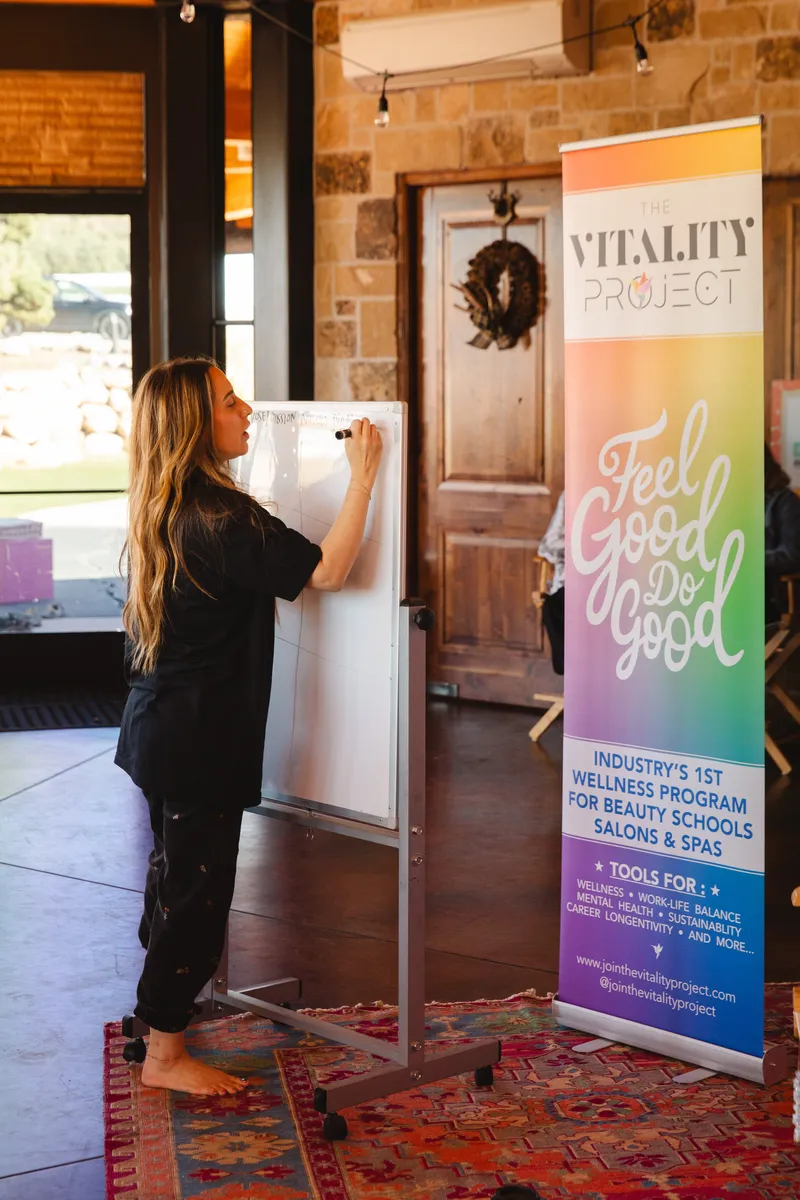


Every lesson, challenge and check-in is built around six dimensions of Vitality, the foundation for healthier students, stronger educators and a school people want to stay in.

 Mental VitalityTools to strengthen your mindset, improve focus and protect your mental health.
 Physical VitalityEnergy, healthy habits and nervous system support to care for your body throughout your career.
 Spiritual VitalitySpiritual growth through values, purpose and meaning, so the work connects to something bigger.
 Emotional VitalityResilience, emotional regulation and practical tools to help you navigate stress.
 Social VitalityLeadership, communication, conflict resolution and the soft skills a professional career runs on.
 Occupational VitalityCareer longevity: a sustainable career, planned for from the first day of school rather than the fifth year.
Turnkey. Easy to implement. Built to make a real difference. See how leading beauty schools are using The Vitality Project to support student well-being, strengthen educators and build healthier school cultures without adding more to their plates.
We’ll walk you through exactly how it works and show you what the program, rollout and pricing would look like for your school.

Stand out in the beauty school marketplace. The Vitality Project provides a wellness curriculum and culture systems for your teachers and students. Together, we support you and your people.
We cannot assume these skills are common sense. We must make them common knowledge through education.
 Retention
 RecruitmentMental, emotional & physical health longevity
 Engagement, all generations & neuro diversities
 Conflict resolution
 Trauma informed coaching trainingStress management
 Burnout prevention
 Social emotional learning
Nervous system education, emotional intelligence, burnout prevention, boundaries and communication, career sustainability, and leadership foundations, woven into an easy-to-teach system your educators will love.
Easy to use, built-in wellness curriculum for students’ and teachers’ growth. Prevent burnout. Comes classroom ready.

Meditations, movement practices, breathwork. All readily available with instant access for staff, teachers or students anytime, anywhere.
Easy onboarding, ready to teach in one hour, and hands-on support to implement in the classroom, clinic floor and across your whole staff.

From the first tour to the last day, here is where the program lives in a school.
Give future students a reason to choose your school over your competitors. When prospective students are comparing schools, show them something bigger than curriculum and licensure: a school that invests in the person behind the professional.

Give your admissions team something meaningful to sell. When a prospective student is deciding where to invest their time, money and future, every school has a curriculum to point to.

Set the energy on day one. Orientation is where students decide how they feel about your school, so make it the moment they get excited and motivated.

Fourteen core lessons, right at the start. We recommend teaching the fourteen core Vitality lessons in Phase 1, the foundational period for new learners.
See the soft skills in action. The clinic floor is where students meet real clients, and where what they learn in Vitality becomes what they do every day: holding a conversation, handling a hard client, resetting between appointments.


Give the program a room of its own: a Vitality Pod. Think of it as a zen den, the kind of small space lots of companies now have, where a student or educator can step in, breathe, reset and go back in.

Teachers are the heart of a school, so we pour into them. Every teacher gets the program for themselves, not only your Vitality Ambassadors, so it becomes part of your culture and your training.

The last months of school are about life after the license. Students graduate with boundaries, a way to reset between clients and habits that hold up in a salon, a spa, a barbershop, a lash studio, wherever their career takes them.
Client love
Foster a people-centered culture, built on continued growth, wellness and health. Because what’s good for people is good for business.
 School
“Their anxiety is so bad that they keep wanting to quit. But knowing that their teacher has that same anxiety and talks about realigning with their own values made them not quit. And that feels like such a win for me.”Jillian de la Rosa TullyPhase One Cosmetology Instructor · Ogle School, San Antonio
 School
“They need that hour. They look forward to that hour. They know that’s an hour where they can solely shut off everything and be present in the classroom.”Megan SimonneauCosmetology Instructor · Bellus Academy, Manhattan campus
 School
“Educators try to pour while their cup is empty, while they’re in pain, while they’re grieving, while they’re going through all the things, but they’re still showing up.”Mimi HawkinsEducation Support Manager · Ogle School, Central Dallas
 School
“My mom and I sat down one day and did the journaling activity from one of the lessons together. We ended up having a really meaningful conversation, and she cried. It was good.”Journei BalesAdvanced Esthetics Educator · Crave Beauty Academy
 School
“I even talk about, 'I have access to this stuff too. It helps me. I've been in the industry for 12 years. Trust me, take advantage of it.'”Crystal MarreroAdmissions Director · Ogle School
 School
“Your stuff resonated so much when you said 'we're not their therapist.' It's something our educators struggle with.”Kristen BagleyRegistrar · The Elaine Sterling Institute
 School
“Let's give each other grace. Let's motivate each other. Let's pat each other on the back and support each other and celebrate the small wins.”Rachel GravesEducator · Tricoci University
 School
“I have coached a couple of our students that were just more comfortable with having somebody face to face on campus, just making sure that they know what tools and resources that they have as well.”Janae GoingsCosmetology Instructor · Ogle School, North Dallas campus
 School
“I appreciate Ogle Nation as a whole for having the Vitality Project and being concerned with the well-being of students and staff alike.”Tracie PageCurriculum Development Specialist · Ogle School
 School
“Honestly I just love the magic that this program brings to our school.”Zach SchneiderInstructor · Tricoci University
 School
“Highlighting the Vitality Project has been a very big win for us. It’s definitely one of the highlights of my interviews that I get to implement, and I get a lot of positive feedback. They’re really excited to dive into that side.”Lisa ConwayAdmissions · Ogle Schools
School“I think it has brought us closer as a team. It allowed for us to really be able to come together as a team to build each other up, as well as stand in for the students.”Rachel GravesEducator · Tricoci University
School“I know it’s working. I’ve seen it firsthand, not just talking about the admission side, but being on campus. I have had students logging into the Vitality Project in real time sitting side by side with me.”Crystal MarreroAdmissions Director · Ogle School
School“If your head is in another area, then maybe your cut isn’t going to be as precise as it could be if you were grounded while you’re with your client. If you’re not well, then you’re not doing your job well.”AdeleCosmetology student
School“We’re incredibly focused on technical skills and book knowledge, but we don’t spend enough time teaching people how to take care of themselves. The Vitality Project fills that gap.”Michelle DietrichSenior Director of Campus Operations · Ogle School
School“Our students didn’t know what wellness was until we brought the Vitality Project into our curriculum.”Karlas MoranSupervising Instructor · Shore Beauty School
School“The Vitality Project has helped me learn how to be there for other people without carrying everything home with me.”AddisonCosmetology student · Eric Fisher Academy
School“I don’t want to miss out on life because of work and school. Learning to set boundaries has helped me realize I can still give my clients everything I have without taking their struggles home with me.”MaddieMaster esthetics student · Taylor Andrews Academy
School“If I could have had this back when I was in beauty school, I think my life would be in a totally different area now.”Rosa MontezClinic Service Manager · Ogle School, San Antonio
School“Burnout happens, but having these tools makes it less hard. Vitality reminds us that we’re not alone and that we can do this.”JerikaCosmetology student · Eric Fisher Academy
School“I think these are skills every beauty school student should learn because they don’t just prepare you for your career. They prepare you for life.”MaddieCosmetology student · Eric Fisher Academy
School“The Vitality Project gives students practical tools they can immediately implement in their daily lives, and that’s when the real change starts to happen.”Aimee FreemanEsthetics Learning Leader · Eric Fisher Academy
School“Having the Vitality Project at our school shows that they care about more than just us getting our license. It shows they care about us as individuals and about the journey we’re on while we’re here.”BrayleeHair design student · Taylor Andrews Academy
School“I’ve actually found out their ambitions, where it stems from, why they ended up choosing this industry, how their last job connected to what they’re studying right now.”Laura IbarraEsthetics Instructor · Bellus Academy, Chula Vista campus
School“Meditation used to sound silly to me, but now it’s one of the tools I rely on most.”AlexandriaMaster esthetics student · Taylor Andrews Academy
School“I’m a mom, I work full time, and I go to school full time. Having these tools gives me permission to slow down for a moment and take care of myself so I can show up better in every area of my life.”DallasCosmetology student · Taylor Andrews Academy
School“Everyone has wellness. Just like physical health, everyone has mental health.”Rachel DamicoDean · Shore Beauty School
School“Wellness is an area we have to prioritize or our industry is going to suffer even more than it already has. The Vitality Project gives us a way to start those conversations and equip students with tools they’ll carry into their careers.”Rochelle CarrDirector · Tucson College of Beauty


Helping beauty entrepreneurs with big missions change more lives. Helping human centric beauty organizations change the world.
Before launching The Vitality Project, Elizabeth Faye spent more than a decade coaching and helping change the lives of more than 30,000 paying clients. Her retreats, coaching programs, and communities created the foundation this work was built upon. She has worked alongside some of the beauty industry’s most recognized names and is now bringing everything she has learned into one connected experience.
A hairdresser turned trauma-informed life and health coach, somatic facilitator and workplace wellness expert, she brings mental health, healing and leadership into beauty in a way that is practical, critically needed and deeply human. She is a TEDx speaker, podcast host, author, and co-director of an award-winning documentary on Amazon Prime.
At the center of her work is The Vitality Project, the beauty industry’s first true workplace wellness program, built to integrate directly into salon systems and beauty school curriculums so professionals are protected and people first cultures actually get built. It is rooted in one belief: that each person has the power to create meaningful change.
Burnout shouldn’t be the cost of success.
Very. It plugs into your existing learning pathway and can be taught live, digitally or hybrid. Every lesson stands on its own, so follow our recommended path or reorder it to fit.
All onboarding is digital and takes about 45 minutes. Schools do it themselves all the time, and we still give hands-on help with the kickoff for new clients to get things rolling. We are experts at making this program fit your school’s cadence. See The Vitality Project in Schools for a layout of every touchpoint: how to make wellness part of your school’s culture and curriculum from recruitment to the clinic floor.
14 core lessons. Each comes with a guided video, a workbook, a done-for-you lesson plan and an automatically graded assessment in your portal. Everything is digital, so you can go green or keep costs lean, and for an additional cost you can add beautiful printed textbooks. Students and staff also get The Vitality Project On Demand audio tool.
About an hour live, including all activities and time for shares. Roughly half that digitally, so plan on 30 to 45 minutes for a hybrid lesson.
Honestly, we have cadences we recommend across the board, and we have also created custom cadences for schools that needed something unique or different, and they have worked incredibly well. If our suggestions do not fit your school’s setup, we will customize them. In general, what follows is what 80% of our schools do.
The Vitality Project runs through every touchpoint of your school: recruitment and orientation, the classroom, the clinic floor, teacher moments and the culture and lifestyle of the school itself. The 14 core lessons are taught in the first 90 days, at 1 to 2 lessons a week (3 in a week is fine at the start).
After that, a monthly cadence keeps it alive. Each month one of the 14 lessons becomes the wellness theme of the month: the whole school does a mini Vitality Retreat together, playing that lesson’s video, once a month, school-wide. Between retreats, 10 to 15 minute Wellness Wednesday huddles keep the theme going with actionable ways to bring it into teaching and learning, and teachers even make wellness boards. It is very easy. See The Vitality Project in Schools: How It Works.
Three teacher trainings at no extra cost, Elizabeth’s signature corporate wellness sessions: Heart-Centered Leadership, The Power of Language and Trauma-Informed Facilitation, each with its own lesson plan and activities. We recommend teachers complete them within the first 12 months and revisit them yearly.
They work asynchronously or synchronously, so teachers can go through them on their own or as a team. Companies love to run them as a mini retreat together, and they are a great tool for new hires in their first 90 days. It will create the best teachers you have ever had.
We are also hands-on as a company. Depending on your school size, we work with you over Zoom to train the trainers, develop your Vitality Ambassadors and support your team with workplace wellness.
Fully digital. A 45-minute video series, plus a Look At A Glance guide, walks teachers through the tools and lessons before they teach. New hires go through the same system. We suggest naming one or two Vitality Ambassadors to own the curriculum.


